


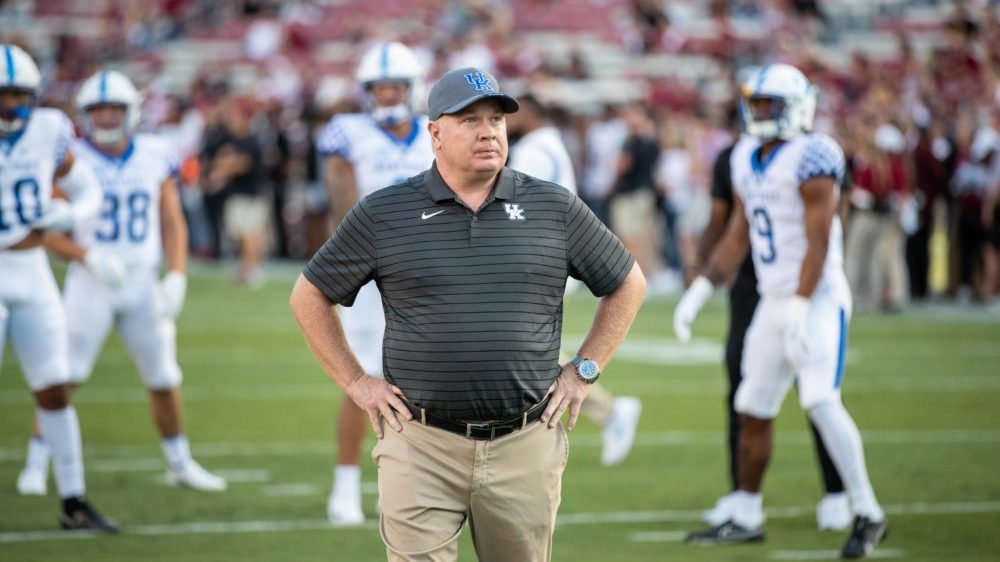
Mark Stoops knows how much NIL money can impact recruiting. (Photo by Vicky Graff)
For those that have been keeping up with college sports, the NIL (name, image and likeness) program has become a huge topic recently. Obviously allowing athletes the opportunity to financially benefit from selling their name, image and likeness via advertising contracts, personal appearances, clothing lines and a myriad of other avenues can be extremely beneficial to the athletes and their families. But is it good for college sports?
In the long run will college sports be better served by having an NIL program that allows all athletes to earn money for participating in college sports?
A lot of people in the college sports world have an opinion on that and I thought I’d share a few so that you can form your own opinion about whether college sports going forward will be a great place for fans, coaches and athletes alike.
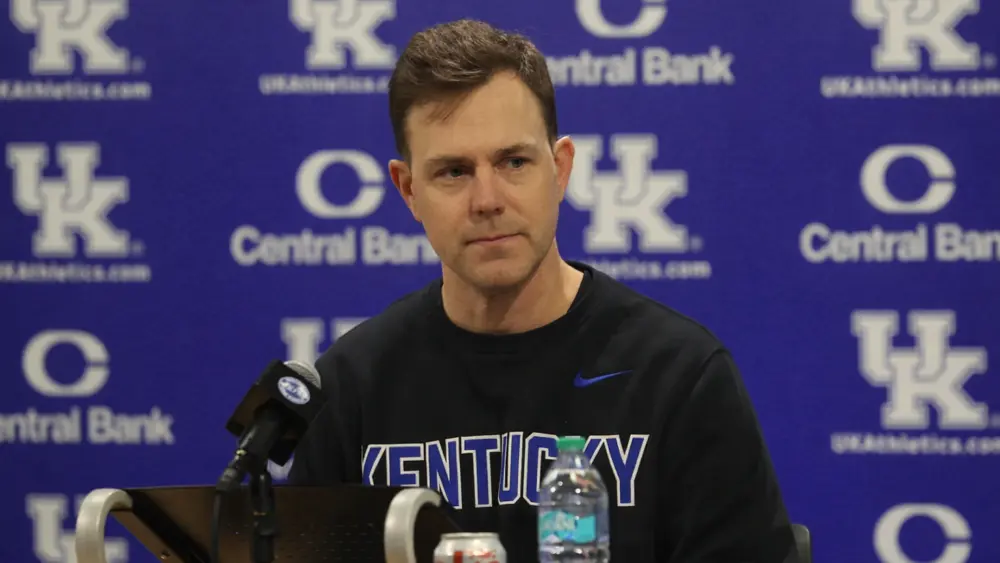
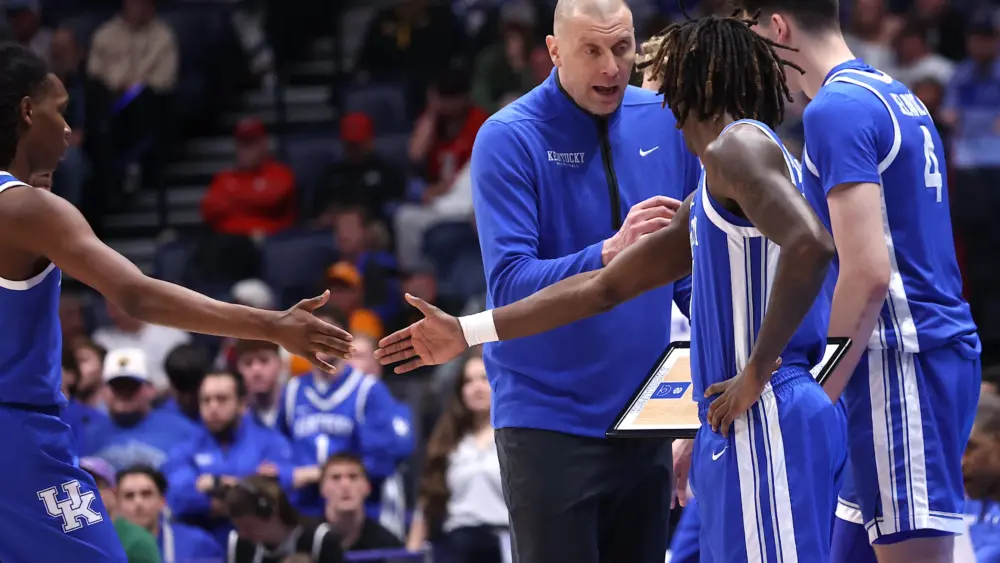
Recently Kentucky basketball coach John Calipari testified about his opinions concerning NIL before a Kentucky Senate Committee considering a bill that would create a legal platform for NIL activities going forward in Kentucky. Calipari, when asked if NIL would improve the landscape of college sports in general and basketball in particular, said, “The kids that have made mistakes leaving early will stay. Maybe a kid that would be drafted in the Top 10 and he says, but I’m not ready, but I have to go (to the NBA Draft). But now it’s no you don’t, no you don’t. Make the right decision for the long run for your career. I believe that the ones it needs to help, or help them make a decision, it will.”
So count Calipari as a big supporter of the system, and one can see why he would be. UK might have won several more national championships if NIL had existed when Calipari came to Kentucky in 2009.
Kentucky football coach Mark Stoops also recently expressed his opinion on NIL and the impact it is having on college football recruiting.
“I think if you asked most coaches — I’m starting to see some SEC coaches and others — discussing all of our concerns on our players, guys that are here, we all are happy that they’re able to profit from their name, image, and likeness. They do a lot for us,” said Stoops. “With that, they should be able to earn some money. I think we all are a bit concerned about the ‘let’s just put a collective together with $10 million and buy recruits’. Let’s buy 25 free agents a year. Is that really what we got into this for? Or did we get into it to support the Chris Rodriguezes and others and guys that have done so much for us.”
And there in lies the rub. Stoops has hit the nail directly on the head in my opinion.
Rumors have been floating around now for several months concerning a collective (boosters that go together and donate money to create an limited license corporation with the sole intent of paying players to sign with their school) that was put together at Texas A&M to “buy” players and ultimately A&M ended up with a recruiting class in 2022 that is said by some media outlets to be the greatest football recruiting class of all time.
Another more recent rumor linked the recruitment of top ranked quarterback Nico Lamaleava to an $8 million dollar payment from a Tennessee collective to get the 2023 recruit to sign with the Volunteers.
So we know that all these collectives are legal. Stoops acknowledges that. He said (somewhat tongue-in-cheek) about the advent of collectives and their ability to buy players, “Let’s just get a collective and let’s get 15 wealthy boosters together, put it in a collective — which is legal. I want to make that clear to everyone that wants to put it in a collective that is totally legal. You’re just essentially putting that money in for futures. Much different than when people say ‘hey, I’m going to advertise for the Masters next year or the Super Bowl next year’. You don’t know who’s going to be in it, but you’re allowed to put that in there. That is totally legal. Whether I want that or not — whether our administration wants that or not — that’s not our choice. It’s legal.”
Meaning that boosters are throwing money into the NIL “pot” without having any idea who that money will be paid to as part of an NIL deal. The boosters are leaving it up to the coaches to bring in the very best players using the NIL money that boosters have provided to the “collective.”
Stoops seems to believe — and rightfully so in my opinion — that college sports, especially in the cash-laden SEC, has become a “Wild West” of sorts with the introduction of NIL (and their respective collectives) and with that type attitude come some unintended consequences.
“I think you see some universities and some SEC schools taking full advantage of that (NIL collectives). And you see others that are not because there’s only so much money to go around. Where are you going to put that money?” Stoops said recently.
“It’s changing the landscape and anytime you make drastic changes like that there are certainly some unintended consequences that come with these decisions. Again, I think it’s a positive, but I’d like to see some federal help or some federal legislation on the total pay-for-play that’s going on right now. That was supposed to be illegal. But it’s certainly not being enforced.”
When asked, Stoops said he believed that schools were buying players through the NIL program. “It’s 100 percent happening out there,” said Stoops. “So what are we going to do about it?”
That is the multi-million dollar question. Kentucky athletics director Mitch Barnhart said in a recent interview that he believed the Federal Government needs to step in and pass legislation that would unify the NIL rules for all 50 states.
Barnhart said, “There is no question that a federal solution that creates a single standard for all student-athletes in all states is the best path forward. We also believe that we shouldn’t wait for one uniform federal policy to continue finding ways to support our student-athletes and ensure that they have the best possible experience in their name, image and likeness.”
And because of that the UK Administration has pushed hard for new laws within the Commonwealth of Kentucky to protect NIL deals signed by college athletes while also providing some type of legal framework within which they can work.
So back to the original question. Is NIL a good thing for college sports in the long term?
Because there are so many different opinions on NIL — its benefits, its long term impacts to the game and where it is heading in the future — my next article will cover the thoughts of coaches and media members outside the immediate UK family.
I think you’ll find their comments very interesting.
3 Responses
No
I guess the value of a college education as well as connections one makes does not really amount to much except to for the big name players. But then isn’t this whom NIL will benefit. Sounds like we’re competing to whomever can pay the most will get the best. More of the same.
They didn’t know this would turn into mess in amateur sports? My, My! Anytime big money gets involved in recruiting wars for college talent there will soon be trouble, with losers of top talent pointing fingers at the winners. That is already happening if you look towards College Station. This NIL deal will be the ruin of college sports as we once knew it, and for many players and schools, just watch. Not every kid on the team is going to get a big time NIL deal. That alone could wind up dividing a locker room, creating a caste system within the team. This policy is starting to go off the rails already. It is legalized cheating, and it will turn into bidding wars for top players, and which ever little pool has the most cash to buy players for their school wins and they get the bulk of the great ones. How is that fair for all schools and players in college athletics? Answer, it ain’t!
Comments are closed.